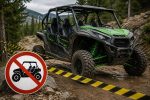
The Kawasaki Teryx H2 is one of the most powerful side-by-sides on the market, but some owners have experienced serious problems involving the vehicle’s CVT clutch system. These issues eventually led to a stop-ride notice and recall affecting certain Teryx H2 models.

If your Kawasaki Teryx H2 has been sidelined by clutch failures, repair delays, or recall-related downtime, you may have rights under California Lemon Law.

What Is the Kawasaki Teryx H2 Recall?

Kawasaki recalled certain Teryx H2 models after discovering that a component within the primary clutch assembly, known as the drive converter sheave, could crack or fail during operation.

A failed clutch component can damage the CVT system and may create safety concerns. As a result, Kawasaki instructed affected owners not to operate their vehicles until repairs could be completed.

The recall repair includes replacement of affected clutch components, installation of additional protective hardware, and a software update.

Common Problems Reported by Owners

Owners have reported:

  • Clutch failures
  • Excessive vibration
  • Belt damage and abnormal wear
  • Loss of power
  • Extended repair delays
  • Vehicles parked for weeks or months awaiting parts

For many consumers, the biggest issue is not simply the defect itself, but the loss of use caused by a stop-ride notice or repeated dealership visits.

Can a Recalled Kawasaki Teryx H2 Qualify as a Lemon?

Yes, in some situations.

California Lemon Law may apply when a manufacturer cannot repair a defect that substantially impairs the vehicle’s use, value, or safety.

Your Teryx H2 may qualify if:

  • The clutch or CVT system required multiple repair attempts
  • The vehicle was out of service for an extended period
  • The defect continues after repairs
  • The recall prevented normal use of the vehicle

A recall does not automatically make a vehicle a lemon, but it can be important evidence that a serious defect exists.

What Compensation May Be Available?

If your Kawasaki Teryx H2 qualifies under California Lemon Law, you may be entitled to:

  • A vehicle buyback
  • A replacement vehicle
  • A cash settlement
  • Recovery of attorney fees

Speak With a California Lemon Law Attorney

If your Kawasaki Teryx H2 has suffered clutch problems, repeated repairs, or lengthy downtime, you may have legal options. An experienced California Lemon Law attorney can review your repair history, explain your rights, and determine whether you may be entitled to compensation.

Don’t assume that a recall solves the problem. If your Teryx H2 has spent more time at the dealership than on the trail, it may be time to explore your Lemon Law rights.

Contact Us Today!

Certain model-year 2020-2025 Jeep Wrangler 4xe and 2022-2026 Jeep Grand Cherokee 4xe vehicles were manufactured with high-voltage (HV) battery packs that may contain defective cells. The defect can lead the battery to internally fail and potentially cause a vehicle fire – whether the vehicle is parked or driving.

What’s the problem?

  • On July 3, 2025, the manufacturer’s technical safety organization opened an investigation after reports of fires originating in the HV battery packs of these plug-in hybrid vehicles – including vehicles that had already undergone the earlier remedy under Recall ID 95B (NHTSA ID 24V-720).
  • The battery supplier Samsung SDI obtained a pack from a vehicle that had experienced a fire with cells manufactured outside the original recall’s scope. They found the fire was caused by the same defect identified under 95B and are working to identify additional causal factors.
  • As of October 13, 2025:
    • 9 fires reported in vehicles which had already had the 95B software remedy applied.
    • 10 fires reported in vehicles whose cells were outside the original 95B scope.
    • 19 customer-assistance records, 0 warranty claims, and 19 field reports tied to this issue (dates from Jan 27 to Sept 2, 2025).
    • 1 injury and no confirmed accidents tied to this issue.
  • On October 24, 2025, the manufacturer determined there is a defect affecting motor vehicle safety in all affected vehicles.
  • The manufacturer states that in rare cases, a battery pack may contain cells with separator damage which, combined with other complex interactions within the cell, may lead to a fire.
  • A key interim safety measure: risk is lower when the battery charge level is low or depleted, and higher when the battery is fully or highly charged.
  • Owner advice: refrain from recharging the vehicle, and park away from structures or other vehicles until the final remedy is available.
  • The recall campaign number is 68C (NHTSA campaign number 25V-741) and even vehicles previously recalled under 24V-720 or 23V-787 will need the new remedy.

Affected vehicles

  • Model year 2020-2025 Jeep Wrangler 4xe
  • Model year 2022-2026 Jeep Grand Cherokee 4xe

What should owners do now?

  1. Minimize risk until fixed:
    • Avoid charging the plug-in-hybrid battery.
    • Park the vehicle outdoors or away from other vehicles/structures (such as garages) when practicable.
    • Try to keep the battery’s state of charge as low as is reasonable for your use.
  2. Wait for the remedy: The final repair or battery replacement is under development. Interim notification letters are expected to be mailed starting December 2, 2025, with additional letters once the remedy is ready.
  3. Follow dealer instructions: Once the remedy is available, schedule service promptly. The remedy may include software updates to the battery management/control module plus potentially a full HV battery pack replacement.
  4. Stay informed: Keep track of recall updates and announcements.

Why this matters: safety & resale considerations

  • A fire originating from a plug-in hybrid’s high-voltage battery is a rare but serious risk: it can pose danger to occupants, first-responders, and bystanders, and damage property.
  • Even if your vehicle hasn’t shown signs of the defect, being part of the recall means you should treat it as a potential risk and act accordingly.
  • From a resale/ownership value perspective, vehicles under open safety recalls can be harder to sell or may need disclosure depending on local laws. Completing the remedy promptly is beneficial for overall vehicle value and peace of mind.

Bottom line

If you own a 2020-2025 Jeep Wrangler 4xe or a 2022-2026 Jeep Grand Cherokee 4xe, this is a recall you cannot ignore. While the risk may only affect a minority of vehicles, the potential consequence is serious. Until the permanent fix is installed, follow the safety advice strictly: no recharging, park away from buildings, and monitor for dealer communications. Once the remedy becomes available, book the service as soon as possible. Your safety – and the safety of others around your vehicle – depends on it.

Lemon laws are American state laws that provide help for purchasers of cars and other consumer goods who have bought products that repeatedly fail to meet the standards of quality and performance.

Each state imposes different requirements for their lemon laws, but a basic condition common to almost all jurisdictions is that in order for the lemon law to apply, the automobile or product must have been purchased with a warranty. Products purchased “as is” are typically not covered by state or federal lemon laws.

The California lemon law applies to all new and used vehicles, whether purchased or leased, for personal and most small business use. Learn more about the California Lemon Law Requirements

(Note: Names have been omitted and some information may have been changed to protect client privacy.)

We recently met with a San Bernardino, California resident who had purchased a  new 2008 Chevrolet Silverado at a nearby dealership. After only 31,000 miles, the transmission started slipping in second gear and had to be brought to the dealer for repairs. The problem recurred at 46,000, 76,000, and 79,000 miles, but the dealership was unable to repair the problem. At 79,000 miles she  contacted  the Lemon Law Offices of Delsack & Associates to see whether she  qualified for a buyback under the California Lemon Law. Continue reading

The California Lemon Law is designed to protect car buyers who have purchased or leased a lemon. If your new car, truck, or SUV cannot be repaired by an authorized dealer after a reasonable number of repair attempts, you could qualify to get the manufacturer to repurchase your vehicle and get your money back. Used vehicles can also qualify if it was purchased while the manufacturer’s original new car warranty was in effect, or if it was a Certified Pre-Owned (CPO) vehicle. Continue reading