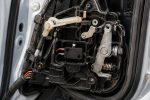
Mercedes-Benz has announced that certain vehicles may be affected by a door lock defect that can interfere with how the vehicle detects whether a door is open or closed. While many owners may have only noticed what seemed like minor electrical quirks, the company determined that, under specific conditions, the problem could present a potential safety concern.

What Is the Problem?

The issue involves a microswitch located inside the door lock assembly. Over time, moisture can penetrate the plastic housing surrounding the switch. In certain climates, this moisture can lead to corrosion of the electrical contacts, causing the switch to send incorrect information about the door’s status.

When this happens, the vehicle may behave as though a door is still open or closed when it is not. Early symptoms often appear to be simple convenience issues, including:

  • Interior lights remaining on after exiting the vehicle.
  • The radio or other electrical accessories continuing to operate unexpectedly.
  • Inconsistent door status detection.

Although these symptoms may seem minor, Mercedes-Benz determined that the underlying defect could have broader implications if left unaddressed.

How the Investigation Unfolded

Mercedes-Benz first began receiving reports of unusual door lock behavior between 2021 and 2024. At the time, the reports primarily involved comfort features, such as radios or interior lights remaining on after the driver left the vehicle. Because these incidents did not initially suggest a safety hazard, the manufacturer continued monitoring the situation.

In May 2025, a report from outside the United States prompted engineers to begin a much more detailed technical investigation. Over the following months, Mercedes-Benz reviewed diagnostic data, examined affected vehicles and components, worked closely with its supplier, and conducted extensive laboratory testing.

The investigation ultimately found that corrosion inside the door lock microswitch could develop when vehicles were exposed to prolonged periods of high humidity, elevated temperatures, and condensation. Frequent use of the doors could further increase exposure to these conditions.

Engineers also discovered that the problem was heavily influenced by climate. In drier regions, moisture absorbed by the switch housing can gradually dissipate, reducing the likelihood of corrosion. This helped explain why reports were concentrated in certain environments rather than being evenly distributed worldwide.

What Mercedes-Benz Found

After comparing laboratory testing with field reports, Mercedes-Benz concluded that the issue was not tied to a particular production period but instead to environmental conditions that allow moisture to accumulate over long periods.

By July 2026, the company determined that a potential safety risk could not be ruled out and decided corrective action was necessary for affected vehicles, including those sold throughout the United States.

How Common Is the Issue?

According to Mercedes-Benz, the company received 176 reports in the United States between March 2021 and June 2026 that were related to this door lock defect.

Importantly, those reports involved comfort-function issues, such as electronics remaining on unexpectedly. Mercedes-Benz stated that it was not aware of any rollaway incidents in the United States associated with this defect at the time of its investigation.

What Should Owners Do?

If you have noticed interior lights staying on, the radio continuing to play after exiting the vehicle, or other unusual door-related electrical behavior, your vehicle should be inspected by an authorized Mercedes-Benz dealer as soon as possible.

The Bottom Line

This issue serves as a reminder that even small electronic components can have significant consequences when they fail. What initially appeared to be a simple convenience problem was eventually traced to moisture-related corrosion inside the door lock mechanism. Through years of monitoring, engineering analysis, and environmental testing, Mercedes-Benz determined that the defect warranted corrective action to help ensure the continued safe operation of affected vehicles.

If you own a 2022 to 2025 Toyota Tundra — including the hybrid models — there’s a recall you should know about. It involves a defect in the reverse light system that could leave you backing up in the dark, quite literally.

This issue affects around 443,000 vehicles, and while it might seem minor at first glance, it raises both safety and legal concerns for California drivers.

What’s the problem?

Toyota found that moisture can get into the reverse light assemblies, which can cause the lights to fail unexpectedly. That’s bad news if you rely on your lights to safely navigate out of a driveway, a parking spot, or a tight alley at night.

Even worse, Toyota says the problem may also point to corrosion in the wiring, which could lead to other electrical issues down the road.

What’s being done?

Repairs are expected to begin in mid-July 2025, and Toyota plans to replace the reverse lamp assemblies and check for corroded wiring. Until then, owners are left waiting — and possibly driving a truck that isn’t fully safe.

Lemon Law and why it matters

In California, the Lemon Law protects you when your vehicle has a defect that:

  • Affects safety or drivability
  • Repeatedly hasn’t been fixed
  • Or causes your vehicle to be out of service for an extended period

If your Tundra has already had issues with the reverse lights — especially if you’ve brought it in more than once — you might have a strong case. The same is true if your truck ends up sitting in the dealership for weeks waiting for parts this summer.

What to do:

  • Make sure you have a copy of any previous service records involving the lighting system.
  • Once repairs are available, get them done — and ask for detailed paperwork showing exactly what was replaced.
  • If your vehicle has been unreliable or unsafe due to this issue (or others), it’s worth talking to someone about your Lemon Law rights.

You shouldn’t have to wait months to feel safe in your truck. And you definitely shouldn’t have to accept defective parts in a vehicle you paid good money for.

If you’re experiencing problems with your Toyota Tundra or have questions about your rights under the California Lemon Law, Call Now for a FREE Case Review – 888-395-3666 or fill in the contact form at the top of the page. Our experienced team is here to help you navigate the process and ensure you receive the compensation you deserve. Don’t wait – take action today to protect your rights as a California consumer!

Volkswagen will be contacting the owners of certain 2013-2016 Audi A4, A5 & Q5 vehicles regarding a problem affecting the electrical connector to the auxiliary heater. According to the defect report, the connector is susceptible to contact corrosion which may cause the auxiliary heater to fail and/or cause the wires to overheat and melt. The problem could result in an electrical fire.

Owners receiving notices will be asked to return to their dealers to have the auxiliary heater replaced, as necessary. Owners wanting more information about the problem can contact Audi customer service at 1-800-893-5298. Volkswagen’s numbers for this recall are 80C5 and 80C6 and the NHTSA campaign number is 17V-622.

General Motors has decided that certain 2014-2016 Chevrolet SS cars may have a defect affecting vehicle safety. According to the defect report, corrosion on the connector between the electric power steering (EPS) module and the torque sensor could result in loss of assisted steering. If power steering is lost, manual steering functionality will be retained, but an increased effort will be needed steer the vehicle. Drivers will also be alerted through a malfunction indicator light and warning chime.

Dealers will inspect the steering gear assembly and replace it as necessary. Owners wanting more information about the problem can contact Chevrolet customer service at 1-800-222-1020. GM’s number for this recall is 17248 and the NHTSA campaign number is 17V-382.

Porsche will be contacting the owners of certain 2015 918 Spyder vehicles, regarding a problem that could increase the risk of a crash. An analysis of a single observation in the field revealed that the lower control arms of the front axle may contain a manufacturing error at the ball joint. Due to variations of the surface coating processes, components and some of the underlying material may have been left unprotected, potentially leading to cathodic stress corrosion cracking (SCC). The problem could affect vehicle handling and increase the risk of a crash.

Porsche will notify owners, and dealers will replace the lower control arms. Owners wanting more information about the problem are asked to contact Porsche customer service at 1-800-767-7243. Porsche’s number for this recall is AG09 and the NHTSA campaign number is 16V-885.

Mazda will be notifying owners of certain 2007-2014 CX-9 crossover SUV’s to return to their dealership for repairs to the suspension system. The affected vehicles have front suspension ball joints that may experience water intrusion into the fitting. The fitting could corrode and the front lower control arm could separate from the joint causing a loss of steering control and an increased risk of an accident. Continue reading

A manufacturing error affecting certain 2014-2015 Acura MDX and MDX AWD vehicles will have approximately 106,439 owners returning to their dealership for repairs.

According to reports, during manufacturing of the A/C compressor clutch drive bolts, certain lots failed to receive the proper dielectric topcoat. As a result, the bolts are more susceptible to corrosion and could break during operation. In addition, some bolt lots did not receive sufficient curing of the e-coat which could result in low torque values and low hardness. The bolts could loosen and fall off during operation. Continue reading