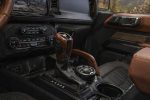
Owners of certain 2021-2025 Ford Bronco SUVs should be aware of a newly announced safety defect affecting the vehicle’s powertrain. Identified under NHTSA Campaign Number 26V-236, this issue impacts approximately 4,922 vehicles and centers around a potentially serious problem with the connection between the transmission and transfer case.

What’s the Problem?

The recall stems from a misalignment that can occur during previous service repairs involving the transmission or transfer case. If these components are not properly aligned when reassembled, it can lead to premature wear of critical internal splines, specifically the transmission output shaft splines and transfer case input splines.

Over time, this wear can reduce the ability of these parts to properly transfer power from the engine to the wheels.

Why This Matters

If the spline wear becomes severe, drivers may experience:

  • Loss of motive power while driving
  • Failure of the vehicle to properly engage “Park”
  • Vehicle rollaway if the parking brake is not applied

These conditions significantly increase the risk of a crash, particularly if the issue occurs unexpectedly while driving or when the vehicle is parked on an incline.

Warning Signs to Watch For

Ford notes that affected drivers may notice early warning symptoms before a failure occurs, including:

  • Grinding noises
  • Clunking sounds
  • Unusual vibrations

If you’re experiencing any of these issues—especially after recent drivetrain service—it’s worth getting your vehicle checked immediately.

How Ford Discovered the Issue

Ford first flagged the problem in November 2025 after reviewing warranty claims on 2022–2023 Bronco models reporting noise, vibration, and drive engagement failures. By December, the issue was escalated internally, and a deeper investigation revealed similar cases across 2021-2025 models.

Engineers ultimately determined that improper alignment during past repairs was the root cause. Testing confirmed that even slight misalignment could reproduce the same wear patterns seen in failed components.

To address this, Ford updated its service procedures on February 26, 2026 to ensure proper alignment during repairs going forward.

How Many Vehicles Are Affected?

While nearly 5,000 vehicles in the U.S. had undergone relevant repairs prior to the updated procedures, only a small number of confirmed cases have been reported so far 26 vehicles globally as of March 2026.

What’s the Fix?

Dealers will:

  • Inspect the transmission-to-transfer case joint
  • Replace the transmission and/or transfer case if necessary

Recall Timeline

  • April 27, 2026: Interim notification letters sent to owners
  • July 2026 (anticipated): Final remedy available and follow-up letters sent

Ford has assigned this recall the internal number 26S26.

What Should You Do?

If you own a 2021–2025 Bronco:

  • Watch your mail for official recall notifications
  • Pay attention to any unusual drivetrain noises or behavior
  • Always use your parking brake when parked (especially on inclines)
  • Contact your local Ford dealer if you have concerns

Final Thoughts

This recall highlights how even routine service work can introduce issues if not performed precisely—especially in complex drivetrain systems. While the number of confirmed cases is relatively small, the potential safety risks make this an important issue for Bronco owners to take seriously.

A major safety concern has been uncovered by Ford, affecting several of its 2024 and 2025 models, including the popular Bronco, Ranger, and electric F-150 Lightning. At the heart of the issue is a potentially faulty front upper control arm ball joint fastener, which may have been improperly secured or even missing altogether. This oversight could lead to a catastrophic failure, where the front upper control arm becomes detached from the knuckle assembly, compromising the vehicle’s stability and control.

The first reported incident involving the F-150 Lightning BEV occurred on March 6, 2025, when a customer’s vehicle suffered a right front wheel failure after just 634 miles on the road. Upon investigation, it was discovered that the upper control arm nut was missing, which had caused the control arm to separate from the knuckle assembly.

Further analysis revealed that the root cause of the problem lies in the manufacturing process, where inconsistencies in the alignment between the fastening tool and the fastener may have prevented the nut from being properly secured. As a result, the ball joint nut may not have been tightened to the correct torque specification, creating a risk of separation.

Drivers who experience this issue may initially notice unusual noises, such as clunks or rattles, when driving over bumps or uneven terrain. However, in more severe cases, the loss of directional control can occur without warning, significantly increasing the risk of an accident.

While the exact timeline for the discovery of this issue on the Bronco and Ranger models is not publicly available, it is imperative that owners of affected vehicles take immediate action to ensure their safety on the road. Ford dealers will inspect and repair the ball joint fastener as necessary, and owner notification letters were sent out on May 23, 2025.

The recall numbers for this issue are 25S45 (Ford’s internal number) and 25V-310 (NHTSA campaign number) for the Bronco and Ranger, and 25V-341 for the F-150 Lightning BEV. If you receive a notification regarding your vehicle, it is essential to contact your local Ford dealer promptly to schedule an appointment and have the necessary repairs carried out.

In conclusion, the safety of drivers and passengers is paramount, and it is crucial that owners of affected Ford vehicles take swift action to address this critical issue. By doing so, they can ensure a safe and reliable driving experience, and minimize the risk of accidents caused by this potentially hazardous fault.

Subaru will be contacting owners of certain 2017 Subaru Outback vehicles regarding a problem affecting brakes and suspension. According to the defect report, the bolts used to attach the front brake calipers, wheel hubs and the right stabilizer clamp may not have been sufficiently tightened. Drivers will be alerted to a problem by a rattling or clunking sound from the front wheel area, especially when brakes are applied. If the attaching bolts loosen or detach, the related components would also become loose and could possibly detach. The vehicle may become unstable and/or no longer provide sufficient braking capability. Continue reading

A problem relating to motor vehicle safety will have almost three hundred thousand 2010-2015 Cadillac SRX and 20112012 SAAB 9-4X vehicles returned to a manufacturer approved repair facility to have the problem fixed.

On the affected vehicles, the jam nut in the rear suspension toe adjuster link may not be torqued to the proper specification. A loose toe adjuster link can cause the vehicle to wander, activate the vehicle’s electronic stability control system, and cause excessive wear to the links threads. Drivers may notice loud metallic noises from the rear suspension when traveling over bumps or potholes. If the treads in the link become worn, the link could separate and create sudden vehicle instability , increasing the risk of an accident. Continue reading

2007-2010 Chevrolet Silverados may make a clunking noise in the rear.

2007-2010 GMC Sierras may make a clunking noise in the rear.

If you think your General Motors vehicle may be a lemon, call the California Lemon Law Firm, Delsack and Associates, at 888-Ex-Lemon (888-395-3666). They are experts in the field with over 21 years of experience.