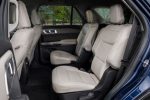
Ford has announced an expanded safety campaign affecting nearly 388,000 vehicles after discovering that a defect involving the second-row easy-entry seats could allow them to tip or slide unexpectedly while the vehicle is in motion.

The issue affects certain 2020-2027 Lincoln Aviator and 2020-2026 Ford Explorer models equipped with second-row easy-entry seats. The expanded campaign carries Ford reference number 26S52 and NHTSA Campaign Number 26V-451, building upon an earlier action that addressed the same concern.

What Is the Problem?

According to Ford, the easy-entry switch used to access the third row can bind or become stuck in the pressed position. When this happens, the second-row outboard seat may unexpectedly unlatch, tip forward, or slide while driving.  The issue is believed to occur when the plastic bezel surrounding the easy-entry switch becomes misaligned. If the bezel interferes with the switch button, it may prevent the button from returning to its normal position after being pressed.  While the investigation into the exact root cause is still ongoing, Ford says broken or misaligned bezel tabs may develop over time during normal vehicle use, even on some vehicles that previously received repairs.

Why This Matters

A seat that unexpectedly moves while driving creates an obvious safety concern. Occupants may suddenly lose their seating position, increasing the risk of injury—especially if a collision occurs.

Drivers may also notice warning signs before the problem becomes more serious, including:

  • Difficulty using the easy-entry feature.
  • The seat failing to return to its normal locked position.
  • The easy-entry button appearing stuck or remaining depressed.
  • Unexpected seat movement after the switch has been used.

If any of these symptoms appear, owners should have the vehicle inspected as soon as possible.

Why Is Ford Expanding the Campaign?

Ford previously launched a safety action in 2025 (NHTSA Campaign 25V-393, Ford 25S67) after identifying incorrectly installed switch bezels at a seat supplier. Dealers were instructed to inspect the switch bezel and replace damaged or improperly installed components.

After those repairs were implemented, Ford continued monitoring field reports.

In the spring of 2026, engineers identified additional reports involving:

  • Vehicles built after the original production changes had been implemented.
  • Vehicles that had already received the earlier repair.

By June 2026, Ford had documented 14 reports of unintended second-row seat movement caused by a stuck switch:

  • 8 reports involved vehicles not covered by the original campaign.
  • 6 reports involved vehicles that had already received the previous repair.

As a result, Ford expanded the population of affected vehicles to include models produced through June 24, 2026, when the original switch bezel design was permanently removed from production.

Which Vehicles Are Affected?

The campaign includes certain:

  • 2020-2027 Lincoln Aviator
  • 2020-2026 Ford Explorer

Only vehicles equipped with the second-row easy-entry seating system are affected.

Approximately 387,911 vehicles are included in the expanded campaign.

How Will Ford Fix the Problem?

Ford dealers will inspect the easy-entry switch bezel and replace the bezel and related components as necessary.

Because the final repair procedure is still being finalized:

  • Interim owner notification letters explaining the safety concern are expected to begin mailing July 27, 2026.
  • A second notification will be sent once the permanent repair is available, which Ford currently expects to be around January 2027.

Repairs will be performed free of charge.

What Should Owners Do?

If you own a 2020-2027 Lincoln Aviator or 2020-2026 Ford Explorer, watch for a notification from Ford and pay attention to any unusual operation of the second-row seats.

If a seat unexpectedly tips, slides, or fails to lock into position, it is recommended that the vehicle be inspected promptly. Even if your vehicle was previously repaired under Ford’s earlier campaign (25V-393 / 25S67), it may still be included in this expanded action.

Owners can verify whether their vehicle is affected by searching their Vehicle Identification Number (VIN) on the NHTSA website or by contacting their local Ford or Lincoln dealership.

Campaign Information

  • Manufacturer: Ford Motor Company
  • Ford Campaign Number: 26S52
  • NHTSA Campaign Number: 26V-451
  • Vehicles Affected: Approximately 387,911
  • Affected Models:
    • 2020-2027 Lincoln Aviator
    • 2020-2026 Ford Explorer
  • Defect: Second-row easy-entry seat switch may stick, allowing the seat to unlatch, tip, or slide unexpectedly.
  • Repair: Inspection and replacement of the switch bezel and related components as necessary.

A manufacturing error will have the owners of certain 2022-2023 Tesla Model Y all-electric SUVs, returning to their dealerships for an inspection and possibly repairs. The second-row seat frame in these vehicles may have been improperly secured.

Tesla first became aware of the problem in December 2022 when an operator in Tesla’s Freemont, CA manufacturing facility identified a second-row driver-side seat back frame bolt that was not torqued to the proper specification.

The second-row seat belt loads go through the lower seat frame, and if the bolts that secure the frame to the seat backs are not torqued to specifications, the seat belt system may not perform as designed during a collision. Occupants seated in the second-row seating positions could experience an increase in the risk of injury during an accident.

According to the defect report, on some Model Y vehicles, the second-row driver-side seat back frame (second-row driver-side and center seating positions) and the second-row passenger-side seat back frame (second-row passenger-side seating position) are secured to the lower seat frame with 4 bolts per seat back. During the supplier’s production of both seat back frames for certain Model Y vehicles, one or more of the bolts that secure the seat back frames to the lower seat frame may not have been torqued to specifications.

Tesla has identified 5 warranty claims, received between December 9, 2022, and February 14, 2023, that may be related to the problem described above. Tesla is not aware of any injuries or deaths that may be related to the condition.

Owners receiving notices will be asked to return to their Tesla Service Centers to have the second-row seat back frames inspected and the bolts will be torqued. Tesla’s number for this recall is SB-23-13-001 and the NHTSA Campaign Number is 23V-130.


If you are the unfortunate owner of a lemon like a Tesla Model Y all-electric SUV with persistent defects that the manufacturer is unable to fix, you may feel like you are out of options. However, there is hope: the California Lemon Law provides some protections for owners of defective vehicles, and a lemon law lawyer can help you navigate the process.

A lemon law lawyer can help you understand your rights under the California Lemon Law and negotiate with the manufacturer on your behalf. They can also help you prepare and submit a claim to the manufacturer and, if necessary, file a lawsuit to protect your rights. Lemon law cases can be complex, and having an experienced attorney on your side can make all the difference in the outcome of your case.

If you are having repeated problems with your Tesla Model Y and you think it could be a Lemon, or if you have any questions about your rights under the California Lemon Law, please call our office at 1-888-395-3666 or fill in the “Case Review” form at the top of this page, and get some great Lemon Law advice!

General Motors (GM) will be contacting the owners of certain 2022-2023 Chevrolet Equinox and 2022 GMC Terrain SUVs because the driver’s seat in these vehicles may have a defect that could affect the drivers safety. The vehicles involved are equipped with powerd driver seats without the memory function.

GM became aware of the problem in July 2022 during noise testing at their assembly plant, after a driver seat frame height adjust pivot bolt was discovered on the floor of one of the test vehicles. The problem was brought to the attention of GM’s Speak Up For Safety program and inspections of vehicles at GM assembly plants and parts returned to the supplier was initiated. GM identified several stripped or loose pivot bolts in power seat frames produced by the supplier between June 30, 2022 and July 15, 2022, and decided to conduct a safety recall.

According to the defect report, the seat frame supplier assembly process did not detect improperly torqued bolts. As a result, the driver seats in these vehicles may have a stripped or loose bolt at the seat frame height adjust pivot. If the seat frame height adjust pivot bolt comes out of the pivot joint, the seat structure may not properly restrain the occupant during an accident and could increase the risk of injury. Vehicle occupants may hear squeaks or rattles coming from the driver’s seat, and/or the seat may feel loose.

Owners will be asked to return to their dealers to have the driver’s seat inspected and replace the seat cushion frame, if necessary. GMC’s number for this recall is N222377890 and the NHTSA campaign number is 22V-724.

If your vehicle is experiencing repeated problems, it could be a Lemon. Know your Lemon Law Rights. If you have any questions about your rights and the California Lemon Law, please call our office at 1-888-395-3666 and get some great Lemon Law advice!

A defect affecting occupant safety exist in certain 2021 Cadillac, Chevrolet and GMC SUVs. General Motors will be contacting owners to return to their dealerships for repairs.

According to the defect report, during installation of the third row seating, one or both outboard seat belts may have been inadvertently entrapped in or miss-routed behind the outboard seat folding mechanism. If a seat belt is routed this way itcould become damaged in the folding mechanism and may not protect occupants during an accident.

If the problem exists, vehicle owners may notice damage to the third row seat belt or may have difficulty latching the belt or operating the third row seat.

Vehicles Affected Include
2021 Cadillac Escalade
2021 Cadillac Escalade ESV
2021 Chevrolet Suburban
2021 Chevrolet Tahoe
2021 GMC Yukon
2021 GMC Yukon XL

GM dealers will inspect the third-row outboard seat belts, replacing any damaged seat belts, and rerouting them if necessary. GM’s number for this recall is N202313000 and the NHTSA campaign number is 21V-190.

Mercedes Benz will be contacting the owners of certain 2017-2018 Coupe vehicles regarding a problem affecting vehicle safety. According to the defect report filed with the NHTSA, a production deviation at the supplier has resulted in front seat back locks that to not lock properly. Unsecured objects in the rear seats might not be held back during a crash, increasing the risk of injury to occupants.

The vehicles affected include:

  • 2017-2018 C300
  • 2017-2018 C43 AMG
  • 2017 C63 AMG
  • 2017-2018 C63S AMG
  • 2018 E400

Those receiving notices will be asked to return to their dealers to have the seat back locks inspected and replaced as necessary. For more information about the problem, owners can contact MBUSA customer service at 1-800-367-6372. The NHTSA campaign number for this recall is 18V-207.

General Motors has decided that certain 2016-2017 Chevrolet Cruze vehicles may fail to conform to the Federal Safety Standards for crash protection. According to the defect report, a bracket used in the driver and front passenger seat back recliner mechanism may have been incorrectly welded to the seat back frame. During a crash, the front seat head restraints could separate, increasing the risk of injury to occupants.

Those receiving notices will be asked to return to their dealerships to have the front passenger seats inspected and replaced as necessary. Owners wanting more information about the problem are asked to contact Chevrolet customer service at 1-800-222-1020. GM’s number for this recall is 17035 and the NHTSA campaign number is 17V-057.

Drivers of certain 2014-2016 Jeep Cherokee‘s may hear squeaks and rattles coming from the seats of their vehicles. Chrysler will be sending notices to owners instructing them to return to their dealerships to have the problem repaired.

According to the defect report filed with the NHTSA, low torque on the first and/or second row seat fasteners could result in squeaks, rattles, deflection or unsatisfactory joint integrity. If the problem is not repaired, it could compromise the structural integrity of the seat. Owners wanting more information about the problem are asked to contact Chrysler customer service at 1-800-853-1403. Chrysler’s number for this recall S63 and the NHTSA campaign number is 16V-590.

General Motors has decided that defects relating to vehicle safety exists in certain 2011 Buick Regal and 2016-2017 Buick Envision vehicles.

  • The first problem affects certain 2011 Regal cars equipped with 8 way power adjustable front seats. The wiring harness for the seats could chafe against the seat frame and cause an electrical short. The problem could result in an inability to adjust the seats, flickering lights on the instrument panel, sparking or smoke from under the seat, and possibly a fire. Dealers will inspect and secure the wiring harness and repair chafed wires as necessary. GM’s number for this recall is 30710 and the NHTSA campaign number is 16V-517.
  • Continue reading