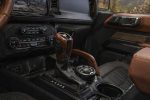
Owners of certain 2021-2025 Ford Bronco SUVs should be aware of a newly announced safety defect affecting the vehicle’s powertrain. Identified under NHTSA Campaign Number 26V-236, this issue impacts approximately 4,922 vehicles and centers around a potentially serious problem with the connection between the transmission and transfer case.

What’s the Problem?

The recall stems from a misalignment that can occur during previous service repairs involving the transmission or transfer case. If these components are not properly aligned when reassembled, it can lead to premature wear of critical internal splines, specifically the transmission output shaft splines and transfer case input splines.

Over time, this wear can reduce the ability of these parts to properly transfer power from the engine to the wheels.

Why This Matters

If the spline wear becomes severe, drivers may experience:

  • Loss of motive power while driving
  • Failure of the vehicle to properly engage “Park”
  • Vehicle rollaway if the parking brake is not applied

These conditions significantly increase the risk of a crash, particularly if the issue occurs unexpectedly while driving or when the vehicle is parked on an incline.

Warning Signs to Watch For

Ford notes that affected drivers may notice early warning symptoms before a failure occurs, including:

  • Grinding noises
  • Clunking sounds
  • Unusual vibrations

If you’re experiencing any of these issues—especially after recent drivetrain service—it’s worth getting your vehicle checked immediately.

How Ford Discovered the Issue

Ford first flagged the problem in November 2025 after reviewing warranty claims on 2022–2023 Bronco models reporting noise, vibration, and drive engagement failures. By December, the issue was escalated internally, and a deeper investigation revealed similar cases across 2021-2025 models.

Engineers ultimately determined that improper alignment during past repairs was the root cause. Testing confirmed that even slight misalignment could reproduce the same wear patterns seen in failed components.

To address this, Ford updated its service procedures on February 26, 2026 to ensure proper alignment during repairs going forward.

How Many Vehicles Are Affected?

While nearly 5,000 vehicles in the U.S. had undergone relevant repairs prior to the updated procedures, only a small number of confirmed cases have been reported so far 26 vehicles globally as of March 2026.

What’s the Fix?

Dealers will:

  • Inspect the transmission-to-transfer case joint
  • Replace the transmission and/or transfer case if necessary

Recall Timeline

  • April 27, 2026: Interim notification letters sent to owners
  • July 2026 (anticipated): Final remedy available and follow-up letters sent

Ford has assigned this recall the internal number 26S26.

What Should You Do?

If you own a 2021–2025 Bronco:

  • Watch your mail for official recall notifications
  • Pay attention to any unusual drivetrain noises or behavior
  • Always use your parking brake when parked (especially on inclines)
  • Contact your local Ford dealer if you have concerns

Final Thoughts

This recall highlights how even routine service work can introduce issues if not performed precisely—especially in complex drivetrain systems. While the number of confirmed cases is relatively small, the potential safety risks make this an important issue for Bronco owners to take seriously.

Chrysler will be contacting the owners of certain 2020 Jeep Gladiator and 2018-2020 Jeep Wrangler vehicles, equipped with manual transmissions. These vehicles have a defective power train that could increase the risk of an accident.

According to the defect report, the clutch pressure plate could overheat and break. Fragments from the pressure plate could fracture the transmission case where debris could enter. Debris entering the transmission could result in loss of propulsion or allow heated debris to contact ignition sources, potentially leading to a vehicle fire. In some circumstances, vehicle occupants may notice a burnt clutch odor, or the driver may notice abnormal clutch pedal travel prior to the failure.

A fix for this recall is still under development. Chrysler’s number for this recall is W12 and the NHTSA campaign number is 20V-124.

Chrysler will be contacting the owners of certain 2014-2016 Chrysler 300, 2014-2016, 2018 Dodge Challenger and 2014-2016 Dodge Charger cars regarding a problem affecting the cruise control system.

According to the defect report, the Mopar Stage 1 Kit Performance Packages Powertrain Control Modules (PCM) and Demon Crate PCM in these vehicles could have a defect that may prevent the cruise control system from disengaging. If there is a short circuit within the vehicle’s wiring while the cruise control is being used, the driver may not be able to shut off the cruise control either by depressing the brake pedal or manually turning the system off . During a short, the driver may be alerted through multiple warning lights illuminated on the instrument panel. If the vehicle continues to maintain speed or start to accelerate, the driver should shift to neutral and/or use the brakes to slow the vehicle and bring it to a stop.

Dealers will correct the problem by performing a software update and replacing the PCM as needed. For more information about the problem, owners may contact Chrysler customer service at 1-800-853-1403. Chrysler’s number for this recall is U82/U83 and the NHTSA campaign number is 18E-053.

Chrysler will be contacting a small number of 2016-2017 RAM 1500 owners regarding a problem affecting their vehicles power train. According to the defect report, the differential retaining screw pin could become loose and contact the bearing cap. If the pin comes out of position, the differential pinion spider gears, the loose screw or the pin itself could make contact with components inside the differential and cause it to break and/or lock up.

Dealers will inspect and replace the differential pin retaining screw in all affected vehicles. If the inspection finds the retaining screw loose or damaged, the entire rear axle assembly will be replaced. Owners wanting more information about the problem are asked to contact Chrysler customer service at 1-800-853-1403. Chrysler’s number for this recall is T20 and the NHTSA campaign number is 17V-198.

The owners of certain 2017 Maserati Ghibli, Levante and Quattroporte cars will be contacted by the manufacturer regarding problems affecting the power train, tires, and backup camera.

Power Train Problems: Certain 2017 Quattroporte and Ghibli vehicles manufactured July 1, 2016, to October 12, 2016, may have been built with a rear differential pinion nut that was not torqued to the proper specifications. A loose pinion gear could bind, possibly resulting in the rear wheels locking up while driving. Maserati’s number for this recall is 328 and the NHTSA campaign number is 16V-856. Continue reading

Nissan will be contacting the owners of certain 2012-2013 Infiniti M35 hybrid vehicles about a software update affecting the propulsion system. These vehicles are equipped with a power train that warns the driver in the event of a cooling system malfunction. If the warning lamp is ignored and the vehicle continues to be operated, the power train control module logic will shut off the engine to prevent damage. If the engine unexpectedly stops while driving, the brake and steering systems remain operational, however, there is an increased risk of an accident. Continue reading

Ford will be contacting the owners of certain 2015-2016 Ford Focus Electric vehicles about a problem affecting the power train system. According to the defect report, certain cars manufactured between August 20, 2015 – April 13, 2016, may have been equipped with differential pinion gear bores without a friction reduction coating. The problem could result in localized overheating and eventual fracture of the pinion shaft or pinion gears. Drivers may hear an audible indication of wear prior to a fracture. Continue reading

Delaimer has decided that a problem affecting powertrain safety exists in certain 2016 Mercedez Benz AMG GT S vehicles. According to the defect report, the strength of the adhesive between the drive shaft and the flange might be compromised due to insufficient cleaning of the respective bonding surfaces. The carbon fiber driveshaft could separate from the flange and spin, resulting in loss of traction between the engine and transmission. Drivers will experience loss of motive power.

Those receiving notices will be asked to return to their dealers to have the carbon driveshaft inspected and replace as necessary. Owners wanting more information about the problem are asked to contact MBUSA customer service at 1-800-367-6372. MBUSA’s number for this recall is 2016050008 and the NHTSA campaign number is 16V-308. MBUSA’s number for this recall is 2016050008 and the NHTSA campaign number is 16V-308.