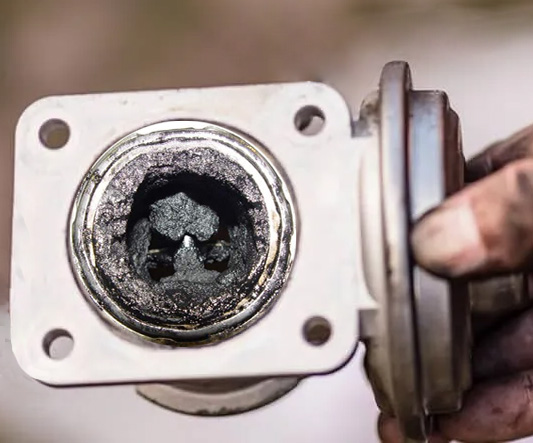
Certain 2013-2014 model year Chevrolet Express and 2013-2014 model year GMC Savana HD vehicles equipped with 6.6L Duramax diesel engines (RPO LGH) could experience a malfunction indicator light (MIL) illumination because of a problem affecting the Exhaust Gas Re-circulation (EGR) cooler.

clogged EGR

EGR coolers can fail for a few different reasons. Coolant passageways become clogged and prevent exhaust gas from cooling, some EGR coolers may be susceptible to corrosion, and repeated cycling of extreme temperatures (thermal stress) can all cause your EGR to fail.

There are a few indications that your EGR is failing: the engine idles rough and stalls; there is an increase in fuel consumption and a decrease in performance; the engine management light is always on, and there is a smell of fuel in and around the vehicle.

General Motors is providing owners of certain 2013-2014 Chevrolet Express and 2013-2014 GMC Savana HD vehicles equipped with 6.6L Duramax diesel engines vehicles, with additional warranty protection. This special coverage covers the problem described above for a period of 10 years or 120,000 miles (193,000 km), whichever occurs first. The warranty covers the vehicles from the date the vehicle was originally placed in service, regardless of ownership.

** GM should notify customers if this special warranty coverage is on their vehicle.**

Repairs and adjustments qualifying under this special coverage must be performed by a General Motors dealer.

View the complete warranty document here: MC-10150564-9999.pdf

General Motors (GM) will be providing owners of certain 2016-2017 Chevrolet, Cadillac and GMC trucks additional warranty coverage because of a problem that could affect the fuel injectors in their engines. The trucks receiving additional warranty are equipped with 5.3L or 6.2L engines.

Vehicles manufactured with these defective fuel injectors include:
2016-2017 Cadillac Escalade
2016-2017 Cadillac Escalade ESV
2016-2017 Chevrolet Silverado
2016-2017 Chevrolet Suburban
2016-2017 Chevrolet Tahoe
2016-2017 GMC Sierra
2016-2017 GMC Yukon
2016-2017 GMC Yukon XL

** GM will notify customers if this special warranty coverage is on their vehicle.**

The special coverage will extend the warranty of the above vehicles, for a period of 10 years or 150,000 miles (240,000km), whichever occurs first, from the date the vehicle was originally purchased, regardless of ownership. This special coverage only applies to vehicles in these states: California, Connecticut, Delaware, Maine, Maryland, Massachusetts, New Jersey, New York, Oregon, Pennsylvania, Rhode Island, Vermont, and Washington.

According to documents released by GM, “Under certain circumstances, one or more of the vehicle’s fuel injectors may deliver an improper amount of fuel to the engine. If this happens, the Malfunction Indicator Lamp (the Check Engine Light) will illuminate to warn the driver there is a problem. The engine will begin to run rough and will eventually stall. Diagnostic trouble codes, including P0300-P0308 or DTC P050D, will be set.

Other symptoms of a bad or dirty fuel injector include: The vehicle is hard to start and idles rough; Poor performance and increased fuel consumption; and an engine knock or detonation that could lead to complete engine failure.

 Automotive Defect Investigation

The NHTSA Office of Defects Investigation (NHTSA) has opened two separate investigations related to unexpected breaking in certain Honda and Tesla vehicles. These vehicles are equipped with collision mitigation braking systems (CMBS) or advanced driver assistance systems (ADAS), which visually and audibly alert the drivers of a potential collision. Under certain circumstances, the system will automatically apply the brakes to help reduce the force of an unavoidable collision.

The problem of unexpected braking has been called “Phantom Braking”. Phantom braking is when a vehicle’s brakes activate unexpectedly even when traffic is flowing normally or there is no obstacle to avoid.

Inadvertent Automatic Emergency Braking
2017-2019 Honda CR-V and 2018-2019 Honda Accord
NHTSA Investigation Number: PE22003

The NHTSA has received a total of 278 complaints and several Early Warning Reports alleging unexpected activation of the collision mitigation braking system (CMBS) in some 2017-2019 Honda CR-V and 2018-2019 Honda Accord vehicles. Driver complaints include high-speed braking incidents occurring with nothing obstructing the vehicle’s path of travel. Of the 278 complaints, 6 allege a collision with minor injuries.

Inadvertent or unexpected braking activation while driving can cause unexpected speed reductions that can lead to increased vulnerability to rear-end impact collisions. The complaints allege that the inadvertent braking events occur without warning and randomly.

Unexpected Brake Activation
2021-2022 Tesla Model 3 and 2021-2022 Tesla Model Y
NHTSA Investigation Number: PE22002

The NHTSA has also received 354 complaints alleging unexpected brake activation in 2021-2022 Tesla Model 3 and 2021-2022 Tesla Model Y vehicles.

Driver reports have been characterized as “phantom braking”. Tesla describes the subject vehicles as equipped with a suite of advanced driver assistance system (ADAS) features referred to as Autopilot which Tesla states will allow the vehicle to brake and steer automatically within its lanes.

The complaints allege that while utilizing the ADAS features including adaptive cruise control, the vehicle unexpectedly applies its brakes while driving at highway speeds. Complainants report that the rapid deceleration can occur without warning, at random, and often repeated in a single drive cycle.

These investigations are a Preliminary Evaluation (PE) to determine the scope and severity of the potential problem and to fully assess the potential of these safety-related issues. If a defect is found, the NHTSA will issue a recall.

In September 2019, the NHTSA was asked to initiate an investigation into certain Tesla Model S and Model X vehicles that received a revised battery management software update in one or more over-the-air updates from Tesla, beginning in May 2019. The petitioner based his request on vehicle fires that took place worldwide and over the air software updates Tesla made to the Battery Management System (BMS) of certain Tesla vehicles that resulted in loss of available vehicle mileage range and increased charging duration’s.

The five non-crash fires referenced in the petition include two fires that occurred in China in early 2019 involving vehicles that:

  • Had recently completed Supercharging sessions.
  • Were at a high state-of-charge (SOC) of the HV battery.
  • Were parked with the battery cooling system shutoff.
  • Had histories of high-stress usage for the HV batteries.

The three fires that occurred outside China did not involve the same patterns regarding vehicle state and charging history. The two fires that occurred in the United States include one involving a vehicle with no Supercharging history that was driving when the fire occurred and another in which the origin of the fire was external to the HV battery. The fifth fire, which also originated external to the HV battery, involved a vehicle in Germany that had been parked at a low SOC for an extended period. To date, incidents of fires involving parked vehicles with recent Supercharging and histories of high-stress use have only been observed in China, where high-stress use factors appear to be more common.

Given the absence of any incidents in the United States related to fast charging, and the absence of any such incidents globally since May 2019, the petition has been denied. The denial of this petition does not stop the Agency from taking further action if future findings find that a safety defect exists based on additional information received. NHTSA could initiate a recall if they find a defect in the design, construction, or performance of a motor vehicle that presents an unreasonable risk to safety.

The NHTSA Office of Defects Investigation have opened an investigation to whether a safety defect related to propellant degradation exists in non-recalled desiccated PSAN frontal air bag inflators manufactured by Takata. This investigation will include information on the Takata production processes, a study of inflators in the field, lists of recall actions that may have used desiccated PSAN inflators as remedy parts, as well as the makes and models originally manufactured with them.

From 2000 through 2017, Takata produced air bag inflators using two types of phase-stabilized ammonium nitrate (PSAN) propellant – propellant 2004 and propellant 2004L. After prolonged exposure to high temperature cycles and humidity, inflators using propellant 2004 can degrade, causing the propellant to burn too quickly when ignited. The rapid burning can cause the inflator to rupture during deployment, potentially causing serious or even fatal injury to vehicle occupants.

“Takata have been studying the long-term behavior of Takata desiccated PSAN inflators using propellant 2004L (as well as 2004) in the presence of moisture and temperature cycling. The research efforts are ongoing and to date, none have identified field evidence showing that propellant 2004L is undergoing a degradation process that leads to aggressive deployment and potential rupture. However, the time in service of such inflators remains short compared to that of the inflators using propellant 2004. Further study is needed to assess the long-term safety of desiccated inflators using propellant 2004L. “

NHTSA Action Number: EA21002

Click Here to see the complete list of vehicles involved in this investigation.

General Motors will be contacting the owners of certain 2020-2022 Cadillac CT4 And CT5 vehicles because of a problem affecting the roof rail side air bags.

In June 2021, GM investigators were contacted by the National Highway Traffic Safety Administration (NHTSA) regarding a right-side roof rail airbag (RRAB) in a 2020 Cadillac CT5 that did not deploy properly during a test for out-of-position occupants. Inspection of NHTSA’s test photos shows a twisted condition between attachment points of the affected RRAB.

In July, a yard hold was initiated at GM’s assembly plant. Inspection of approximately 1,300 vehicles on hold found five vehicles with the twisted RRAB condition. GM is not aware of any accidents or injuries associated with this condition, but have decided to conduct a safety recall.

Dealers will inspect both left and right-side roof rail air bags and reinstall the air bags, as necessary. Owner notification letters are expected to be mailed in September. GM’s number for this recall is N212342780 and the NHTSA campaign number is 21V-611.

General Motors Co. (NYSE: GM) announced it sold 688,236 vehicles in the U.S. in the second quarter of 2021 – an increase of 40 percent compared to a year ago – in a unique market bolstered by strong customer demand, but constrained by low inventories resulting from the global semiconductor shortage.

“The U.S. economy is accelerating, consumer spending is robust and jobs are plentiful,” said Elaine Buckberg, GM chief economist. “Consumer demand for vehicles is also strong, but constrained by very tight inventories. We expect continued high demand in the second half of this year and into 2022.”

“The agility and creativity of our supply chain, purchasing, engineering and manufacturing teams, in collaboration with our suppliers and dealers, have helped us continue to satisfy customers and gain market share in some of the highest demand segments of the market,” said Kurt McNeil, U.S. vice president, Sales Operations.

GM is well positioned in 2021 to lead the industry in full-size and mid-size pickup sales for the seventh consecutive year. During the quarter, GM earned 40.6 percent of the retail market for full-size pickups, up 4.5 percentage points year over year (J.D. Power PIN), with more than 237,000 Chevrolet Silverados and GMC Sierras sold in the quarter.

The company is taking steps to meet customers’ future needs, especially in capacity-constrained segments:

GM announced that production of HD pickups will increase by about 1,000 trucks per month beginning in mid-July as a result of production line efficiencies delivered by the team at Flint Assembly in Michigan.
Also, GM will return full-size pickup production to Oshawa Assembly in Canada at the end of 2021.
Shipments of Chevrolet Colorado and GMC Canyon mid-size pickups built at Wentzville Assembly in Missouri increase by about 30,000 total units from mid-May through early July as the team completes dynamic vehicle testing on units held at the plant due to semiconductor supply disruptions.

GM ended the quarter with 211,974 units in inventory, down from 334,628 at the end of the first quarter.

  • Chevrolet Bolt EV delivers record second-quarter and first-half deliveries.
  • Buick sales rise 86 percent on strong demand for new Encore GX, redesigned Envision, and Enclave, creating the brand’s best quarter in more than 15 years.
  • GMC records best second quarter and best first half since 2005 driven by Yukon and Yukon XL.
  • Chevrolet Silverado and GMC Sierra sales up a combined 36 percent, with light-duty models posting strong segment share gains.
  • Cadillac’s second quarter retail sales were its best since 2015.

Click Here to read the full report.

In December 2019, the National Highway Traffic Safety Administration ( NHTSA) received a petition that requested an investigation into alleged sudden unintended acceleration (SUA) in certain 2017-2019 Tesla Model 3, 2013-2019 Tesla Model S and 2016-2019 Tesla Model X vehicles. The petition cited 127 consumer complaints including 110 crashes and 52 injuries.

On January 13, 2020, the NHTSA’s Office of Defects Investigation (ODI) opened a Defect Petition (DP20-001) to assess the request. The investigation included reviews of all complaints and supporting information, as well as an additional 14 complaints that were either not included in the petition or were submitted after the petitioner’s submission. The review also included analyses of available crash data (EDR, Tesla log data, and/or video data) the NHTSA acquired from Tesla, as part of the investigation.

After reviewing the data, ODI has not identified evidence that would support a defect investigation into SUA in the subject vehicles. According to the NHTSA, “In every instance in which event data was available for review by ODI, the evidence shows that SUA crashes in the complaints have been caused by pedal misapplication. There is no evidence of any fault in the accelerator pedal assemblies, motor control systems, or brake systems that has contributed to any of the incidents. There is no evidence of a design factor contributing to increased likelihood of pedal misapplication. The theory provided of a potential electronic cause of SUA in the subject vehicles is based upon inaccurate assumptions about system design and log data.”

“NHTSA is authorized to issue an order requiring the remedy of a defect if the Agency’s investigation shows a defect in design, construction, or performance of a motor vehicle that presents an unreasonable risk to safety. Since the information is not indicative of a vehicle based defect, it is unlikely that any investigation opened because of granting this petition would result in an order concerning the notification and remedy of a safety-related defect. Therefore, upon full consideration of the information presented in the petition and the potential risks to safety, the petition is denied. The denial of this petition does not foreclose the Agency from taking further action if warranted or the potential for a future finding that a safety-related defect exists based upon additional information the agency may receive.”